
Racket sports have long captivated sports enthusiasts around the world, with tennis being a staple for over a couple of centuries. In recent years, padel has emerged as a popular alternative, blending elements of tennis and squash into a unique and engaging sport. While they share some similarities, padel and tennis differ significantly in court dimensions, equipment, gameplay style, and scoring. This comprehensive guide will explore these differences to help you understand what sets these two exciting sports apart.
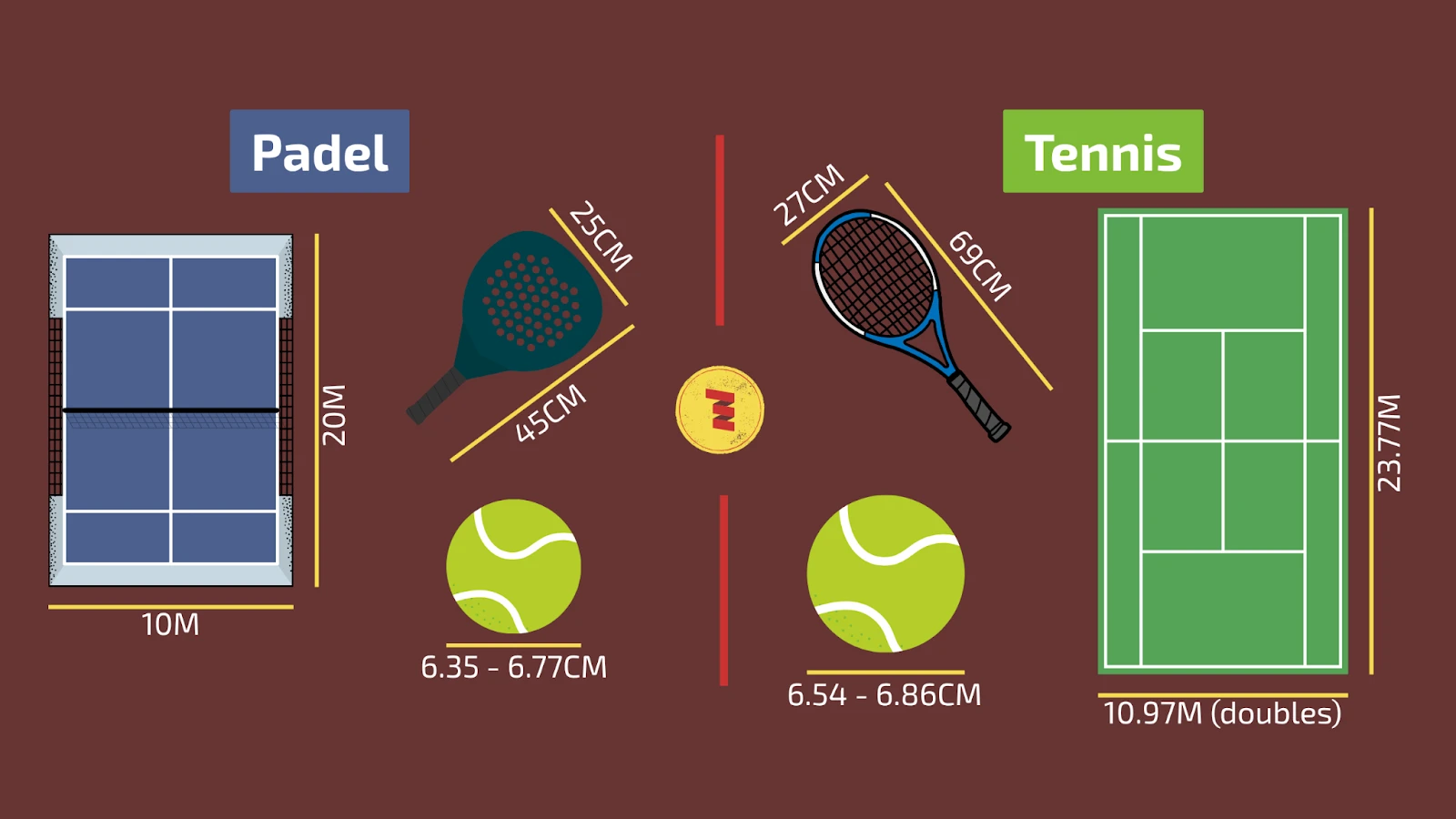
Padel Court vs. Tennis Court: Size and layout differences
Tennis Court
23.77m
length
10.97m
width (doubles)
0.91m
net height
A standard tennis court measures 23.77 meters (78 feet) in length and 8.23 meters (27 feet) in width for singles matches, expanding to 10.97 meters (36 feet) for doubles. The court is divided by a net standing 0.91 meters (3 feet) high at the center. Tennis courts are open, providing ample space for high-velocity serves and long rallies.
Padel Court
20m
length
10m
width
0.88m
net height
Padel courts are significantly smaller, measuring 20 meters (65.6 feet) in length and 10 meters (32.8 feet) in width. The court is enclosed by walls made of glass or solid materials, which are integral to the gameplay. The net is slightly lower than in tennis, standing at 0.88 meters (34.6 inches) in the center. The enclosed space and wall usage create a different dynamic, emphasizing strategy over power.
Importance of walls in padel
One of the most distinctive features of padel is the incorporation of walls into the game. Similar to squash, players can use the walls to rebound the ball, adding a complex strategic layer. After the ball bounces on the court, it can hit the walls before or after your opponent returns it. This allows for creative shot-making and longer rallies.
In tennis, walls are of course non-existent in gameplay. Hitting the ball outside the designated court boundaries results in the loss of the point. The absence of walls means that players rely heavily on spin, power, and precision to outmaneuver their opponents.
Comparing Padel and Tennis equipment
Padel Racket vs Tennis Racket
Tennis Rackets
Tennis rackets have a strung hitting surface, allowing for a trampoline effect that adds power and spin to shots. They vary in size, weight, and string tension, catering to different playing styles.
Padel Rackets
Padel rackets are solid and perforated with holes to reduce air resistance. They lack strings entirely. The hitting surface is smaller and provides less bounce, requiring players to focus on control and placement rather than sheer power.
Padel Ball vs Tennis Ball
Tennis Balls
Tennis balls are pressurized and have a higher bounce to accommodate the larger court size. They are designed for speed and can vary slightly depending on the playing surface (clay, grass, or hard court).
Padel Balls
Padel balls are similar in appearance to tennis balls but are slightly less pressurized, resulting in a lower bounce. This suits the smaller court and the gameplay style that incorporates walls.
Differences in gameplay style between padel and tennis
Tennis Gameplay
Tennis is often a game of power, endurance, and technical skill. Players utilize a variety of strokes, including serves, volleys, groundstrokes, and smashes. The open court demands quick lateral movement and the ability to cover large distances rapidly. Singles matches emphasize individual skill and strategy, while doubles require coordination and teamwork.
Padel Gameplay
Padel is predominantly played in doubles, fostering a strong emphasis on teamwork and communication. The smaller court size and the use of walls lead to longer rallies and a game that prioritizes strategy over strength. Players must be adept at positioning and anticipating rebounds off the walls. The underhand serve in padel is less aggressive than the overhand serve in tennis, making the game more accessible to beginners.
Scoring Systems
While both sports share similar scoring terminologies, using love, 15, 30, 40, and deuce, there are subtle differences in how games, sets, and matches are structured. Tennis matches can be best-of-three or best-of-five sets, especially in Grand Slam tournaments. Padel matches are typically best-of-three sets. The incorporation of tie-breaks can also vary between the two sports.
Accessibility and learning curve
Padel is generally considered more accessible for beginners due to its simplified serve, smaller court, and emphasis on strategy over power. Tennis requires mastering a variety of technical skills and often has a steeper learning curve, particularly concerning serves and groundstrokes.
Where padel and tennis are most popular worldwide
Tennis has a long-established global presence, with major tournaments like Wimbledon and the US Open attracting worldwide attention. Padel is rapidly growing, especially in Spain and Latin America, and is gaining popularity in other parts of Europe, Africa and the Middle East. The social aspect of padel, often played in clubs with a community atmosphere, adds to its appeal.
Key takeaways: Comparing padel and tennis
| Aspect | Tennis | Padel |
|---|---|---|
| Court Size | Larger, open court | Smaller, enclosed with walls |
| Racket Type | Strung rackets | Solid, perforated rackets without strings |
| Ball Type | Pressurized for higher bounce | Less pressurized for lower bounce |
| Use of Walls | Not used; hitting outside is out | Integral part of gameplay |
| Gameplay Style | Emphasis on power and technical skills | Emphasis on strategy and teamwork |
| Serving Style | Overhand serves with high speed | Underhand serves, easier for beginners |
| Typical Match | Singles or doubles | Primarily doubles |
| Learning Curve | Steeper, requires mastering various techniques | Gentle, easy to pick up |
Both tennis and padel offer exciting experiences but cater to different preferences. If you enjoy fast-paced action with a focus on individual skill and power, tennis might be your sport. If you're looking for a strategic game that's easy to learn and emphasizes social interaction, padel could be the perfect choice.
Whether you're a seasoned tennis player curious about padel or a newcomer deciding which sport to pick up, understanding these key differences will help you make an informed decision. Why not try both and discover which one resonates with you?